
// Commercial · Strata · Leases
Commercial and strata dilapidation reports
Commercial dilapidation reports record the condition of offices, shops, warehouses and strata buildings before adjoining works, at the start of a lease or before make-good. Owners, tenants and strata committees get an engineer-signed baseline they can rely on.
// Overview
What is a commercial dilapidation report?
The short answer
A commercial dilapidation report, also called a commercial dilapidation survey or commercial property condition report, is a dated, engineer-signed record of a commercial, industrial or strata building's condition. It's used before adjoining excavation, demolition or piling, at the start of a lease, and before make-good, so any later change can be proven with evidence rather than argued from memory.
Need a commercial building condition report on defects and their likely causes instead? See our building condition assessments.
The method matches our residential reports: located photographs, a measured crack register and an engineer's sign-off. The difference is scale. Facades, basements, car parks, plant areas and common property are planned in zones so the building can keep trading. Read what a dilapidation report includes for the basics.
- Buildings
- Offices, shops, warehouses, industrial and strata buildings
- Used for
- Adjoining works, lease start and make-good
- Covers
- Facades, visible structure, basements, car parks and common property
- Issued to
- Owners, tenants, owners corporations or individual lot owners
- Signed by
- A structural engineer (Engineers Australia · RPEQ)
- Time on site
- Longer than a house; planned around your operations
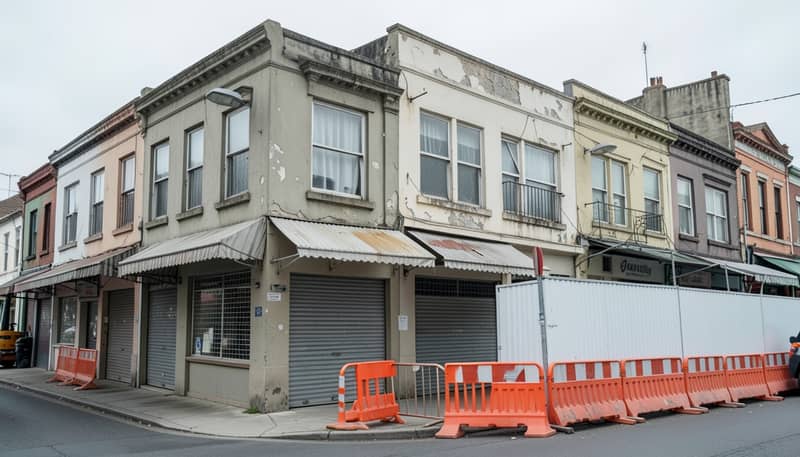 COMMERCIAL · ADJOINING
Key takeaways
- Same method as residential: dated photos, measured cracks, engineer's sign-off.
- A lease-start record means make-good starts from facts.
- Facades, basements and car parks are recorded before adjoining works.
- Inspections are planned around your operating hours where we can.
// When commercial clients call us
When do you need a commercial dilapidation report?
Three situations account for most commercial reports. Each one relies on the same thing: a dated record made before anything changes.
Development next door
Excavation, demolition or piling beside your building can affect facades, basements and car park slabs. A pre-construction record gives the owner or owners corporation a baseline before works begin.
Lease start
A dated condition record when a tenant moves in means fewer arguments when they move out. Landlord and tenant can rely on the same evidence.
Before make-good
Before a lease ends, the premises are recorded again against the earlier record, so make-good discussions start from facts.
If you're the developer, our pre-construction dilapidation reports cover every neighbouring property in one quote. Read when a dilapidation report is required.
// Leases
How do dilapidation reports work for lease start and make-good?
Two records, made at either end of the lease, show what changed while the tenant was in occupation. Without the first one, the second has nothing to be compared against.
- Lease start
Condition record at handover
Walls, floors, ceilings, finishes and visible structure photographed and logged as the tenant moves in.
- During the lease
Record again if works start next door
If adjoining development begins mid-lease, a pre-construction record protects both owner and tenant.
- Before the lease ends
Re-inspect against the start record
The premises are photographed from the same positions and changes are flagged.
- Make-good discussion
Start from evidence
Both parties compare the two records. The obligations themselves come from your lease.
Evidence, not legal advice
Make-good obligations are set by your lease. Our report records condition so landlord and tenant can see what changed. We don't interpret leases, price make-good works or carry out repairs.
What landlords and tenants get
- A dated record both parties can rely on
- Located photos that can be retaken from the same spot
- Measured cracks and defects in a register
- An engineer's signature and clear limitations
// Scope
What does a commercial dilapidation report cover?
We agree the scope in your quote, based on the building and what the report needs to do. See how the sections look in our sample dilapidation report, and what drives the price of a larger report.
| Area | What we record |
|---|---|
| Facades and external walls | Cladding, render, masonry, windows and joints, photographed elevation by elevation |
| Structure we can see | Columns, beams, slabs, transfer areas and visible connections |
| Basements and car parks | Walls, slabs, ramps, joints, water ingress and existing repairs |
| Internal fit-out | Walls, ceilings, floors and finishes in tenancies we can access |
| Common property | Lobbies, stairwells, corridors, roofs and plant areas we can access |
| External works | Paving, retaining walls, boundary structures and public assets at the frontage |

Keep trading
Tell us your operating hours, security and access arrangements when you request a quote. We plan the inspection in zones around them where we can, and confirm the arrangement in writing.
// Strata and public assets
Strata buildings and public assets
Strata buildings beside a development need a record of the common property and, ideally, the lots most exposed to the works. Developers often need the public assets at the frontage recorded too.
Common property
Facades, basements, car parks, stairwells and roofs we can access.
Individual lots
Included where owners give access, each with its own record.
Reports to each party
Issued to the owners corporation and to individual owners as needed.
Public assets
Footpaths, kerbs, gutters, crossovers and road surfaces, where your consent asks for them.
Heritage buildings beside new development deserve particular care. DIN 4150-3, commonly referenced by engineers in Australia, gives sensitive and heritage buildings the lowest vibration guideline values. That makes a careful baseline before piling or rock breaking especially worthwhile, and crack monitoring during the works a sensible addition.
Guideline vibration values at 1–10 Hz, by building type
// Which report?
Which commercial report do you need?
A dilapidation report records condition so changes can be proven later. If you need to know what defects mean, what's causing them and what to fix first, for example before buying a building or planning strata capital works, you need a building condition assessment instead.
Not sure? Choose "Commercial, strata or lease" on the quote form and describe the building. We'll recommend the right scope.
Is excavation, demolition or piling planned next to the building?
Yes → pre-construction dilapidation reportNo → go to 2Is a lease about to start?
Yes → lease-start condition recordNo → go to 3Is a lease ending, with make-good to agree?
Yes → make-good report against the start recordNo → go to 4Do you need to know what defects mean and what to fix first?
Yes → building condition assessmentNo → ask us for advice
// Related services
Other reports we prepare
Pre-construction dilapidation reports
Record every neighbouring property before demolition, excavation or piling starts.
Learn more Owners · Buyers · Strata committeesBuilding condition assessments
An engineer's view of what defects mean, what's causing them and what to fix first.
Learn more During works · MovementCrack monitoring
Track whether existing cracks are moving while nearby works are under way.
Learn more// Questions
Commercial and strata dilapidation report FAQs
Still unsure? Call 07 2150 0579 and an engineer will talk it through.