
// Homeowners next to a build
Building work next door? Protect your home first.
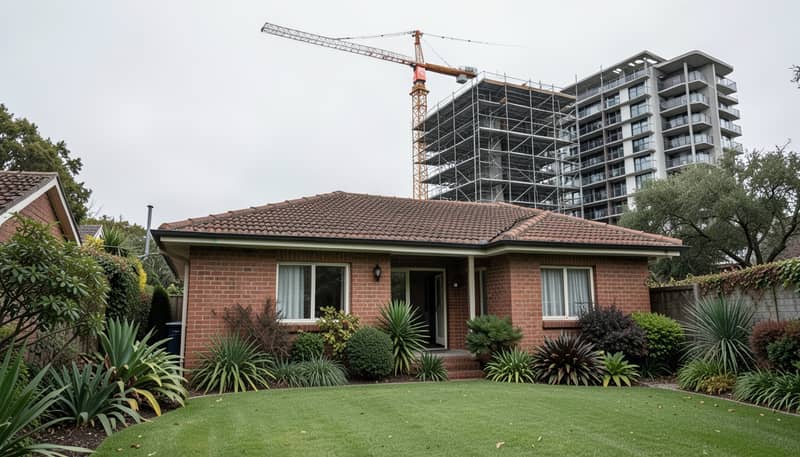
If a neighbour is about to demolish, excavate or build, an independent dilapidation report records your home's condition before work starts. If cracks appear later, you'll have engineer-signed, dated evidence of what was already there and what wasn't.
// Overview
What is a neighbour dilapidation report?
The short answer
A neighbour dilapidation report is your own independent record of your home's condition, made before demolition, excavation or construction starts next door. A structural engineer working for you photographs every room and elevation and measures existing cracks, so if damage appears later you can prove what's new.
Ask whether the builder is doing a dilapidation report and request a copy. If you want certainty, book your own engineer before work starts. Afterwards, it's too late to prove what was already there.
- Who orders it
- You, the owner of the home next to the works
- Who we work for
- You, not the builder or developer
- When
- Before demolition, excavation or piling starts next door
- What's recorded
- Inside and outside, measured cracks and boundary structures
- Time on site
- One to three hours for a typical house
- Price
- From $390 + GST, fixed before we start
 YOUR HOME · BEFORE
Key takeaways
- The builder's report is prepared for the builder. Yours is prepared for you.
- Book before work starts next door, or the baseline is lost.
- Measured cracks prove whether something grew, not just that it exists.
- Letting the builder's inspector in as well is usually in your interest.
// Your options
Builder's report or your own: which do you need?
When a development needs a dilapidation report, the builder or developer usually commissions it to protect themselves. It may be useful to you too. Work through these questions to decide whether you also need your own.
Has the builder offered a dilapidation report of your home?
Ask the builder or developer directly. Many consent conditions require one for neighbouring properties.
Yes → allow access and go to 2No → book your own before works startWill you receive a full copy before works start?
A report you never see can't help you if cracks appear mid-project.
Yes → go to 3No → book your own so you hold the evidenceDoes it cover inside your home and measure each crack?
External, photo-only records miss the plaster, cornice and tile cracks most claims are about.
Yes → it may be enough; keep your own dated photosNo → book your own to fill the gapsHas damage already appeared?
It's not too late to get an engineer's view, but the sooner the better.
Yes → book an inspection nowNo → keep watching for change
| Builder's report | Your own report | |
|---|---|---|
| Commissioned by | The builder or developer | You |
| Prepared to protect | The builder | You |
| Who chooses the inspector | The builder | You |
| Copy to you | May be offered | Sent to you directly |
| Inside your home | Depends on scope | Every accessible room |
| Measured cracks | Varies | Every crack logged |
| Cost to you | Usually none | From $390 + GST |
The builder's report may still be thorough. Ask for a copy and compare it with this list. Read who pays for a dilapidation report.
Why independence matters
We're engineering only. We inspect, record and report, and never quote for repairs, so nothing in your report is influenced by who might be paid to fix the damage.
// Before work starts
What should you do when building work starts next door?
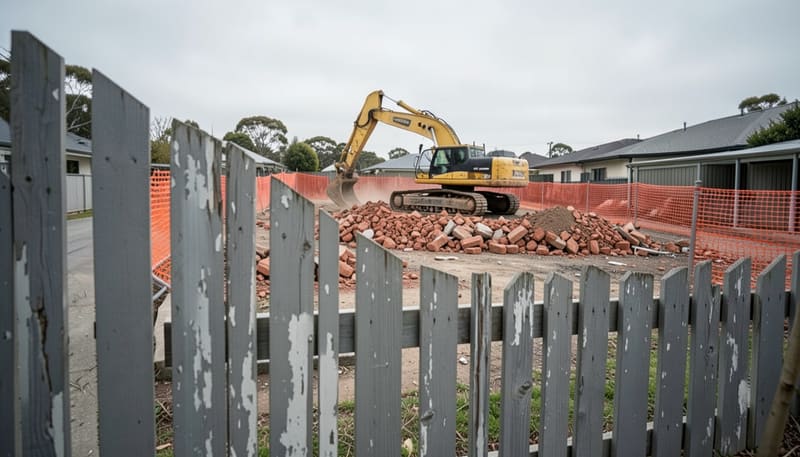
Act before the first machine arrives. These six steps protect you whether or not the works ever cause a problem.
- As soon as you hear
Ask the builder
Ask whether a dilapidation report is planned for your home, and request a copy when it's done.
- Before works
Check the approval
Look at the development approval or building permit for a dilapidation condition naming your property.
- Before demolition or excavation
Book your own engineer
An independent inspection, inside and out, with every crack measured and the signed report sent to you.
- Before and during works
Keep your own dated photos
Photograph existing cracks, especially near the shared boundary, with something for scale.
- During works
Watch for change
Note new cracks, sticking doors or gaps at cornices, and tell the builder in writing straight away.
- After works finish
Compare after the works
A post-construction report re-measures each crack in your register and logs anything new.
Your rights vary by state
In NSW, section 177 of the Conveyancing Act 1919 provides a right of support for land. In Victoria, Part 7 of the Building Act 1993 covers protection of adjoining property. Elsewhere, ask your council about the approval conditions. Our report is evidence, not legal advice.
Read can a neighbour refuse a dilapidation report? if you're unsure about letting the builder's inspector in.
// What we record
What does a neighbour dilapidation report include?
Enough detail that the same crack can be found and re-measured months later, by us or anyone else.
Located photographs
Every external elevation and each room we can access, numbered and located on a plan.
Measured crack register
Each crack's location, width, length and orientation, linked to its photo.
Doors, floors and finishes
Sticking doors, uneven floors, cracked tiles, gaps at cornices and earlier repairs.
Boundary structures
Fences, boundary and retaining walls, paving, driveways and pools near the works.
Engineer's signature
Signed by a structural engineer (Engineers Australia · RPEQ), with the limits of the inspection stated.
Sent to you
The finished report is yours. You decide whether and when to share it with the builder.
See a sample dilapidation report, or read engineer vs building inspector to see why measured cracks matter.
// Signs to watch for
What damage can building work next door cause?
The most common signs of construction damage to a neighbouring property are new or widening cracks and things that stop fitting properly. Watch for:
- New cracks in plaster, render or brickwork, especially stepped cracks in mortar joints
- Existing cracks getting wider or longer
- Doors and windows that start sticking or won't latch
- Gaps opening at cornices, skirting boards or between walls and ceilings
- Cracked tiles, and new cracks in paving or driveways
- Boundary walls or fences leaning towards an excavation next door
Not every crack is caused by works next door. Seasonal soil movement on reactive clay causes plenty of cracking too. That's exactly why a baseline record matters. Read what to do if construction next door damages your house.
// If damage appears
How does the report help if cracks appear?
If you notice changes, a post-construction report re-measures each crack in your original register and logs anything new. An engineer then gives an opinion on whether the nearby works are a likely cause. That's the evidence builders and insurers respond to.
Noticed a new crack?
Photograph it with something for scale, note the date, and tell the builder in writing straight away. Don't patch or paint over it until it has been recorded and measured.
For long or high-risk projects, crack monitoring tracks selected cracks during the works, so any movement is caught early. Not sure what a report costs? See dilapidation report pricing.
// Related services
Other reports we prepare
Post-construction reports
Re-inspect after works, compare against the original record and assess likely cause.
Learn more Owners · Buyers · Strata committeesBuilding condition assessments
An engineer's view of what defects mean, what's causing them and what to fix first.
Learn more During works · MovementCrack monitoring
Track whether existing cracks are moving while nearby works are under way.
Learn more// Questions
Neighbour dilapidation report FAQs
Still unsure? Call 07 2150 0579 and an engineer will talk it through.