
// During works · Movement
Crack monitoring during construction
Crack monitoring tracks whether existing cracks are moving while nearby works are under way. We set monitoring points on selected cracks, take readings on an agreed schedule and report any change, so problems are caught early instead of argued about later.
// Overview
What is crack monitoring?
The short answer
Crack monitoring is the repeated measurement of selected cracks against a baseline reading, to show whether they're moving while nearby works are under way. Gauges or marked points are fixed across each crack, read on a set schedule, and any change is reported with photos and an engineer's comment.
A dilapidation report proves what a crack looked like on one day. Monitoring shows what it did over weeks or months, which is how you tell a crack that's stable from one that opens and closes with the seasons, or one that keeps getting wider.
- What it tracks
- Whether selected cracks are opening, closing or stable
- Tools
- Tell-tale gauges, crack width gauges and calibrated measurements
- When
- Before, during and after the riskiest stages of nearby works
- Compared with
- A baseline reading taken before those works start
- What it shows
- Stable, seasonal or progressive movement
- Best paired with
- A pre-construction dilapidation report
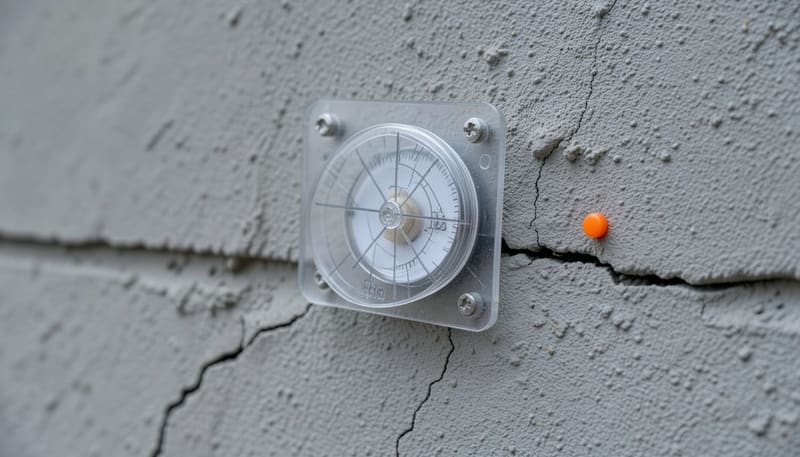 MP-03 · BASELINE
Key takeaways
- A baseline reading comes first, before the risky work starts.
- Repeat readings show whether a crack is stable, seasonal or progressive.
- Movement is reported promptly, while the cause is still easy to identify.
- Builder and owner see the same numbers.
// Method
How are crack readings taken?
Gauges fixed across each crack, or marked points measured with calibrated instruments, read at set intervals and compared with the baseline.
Tell-tale gauges
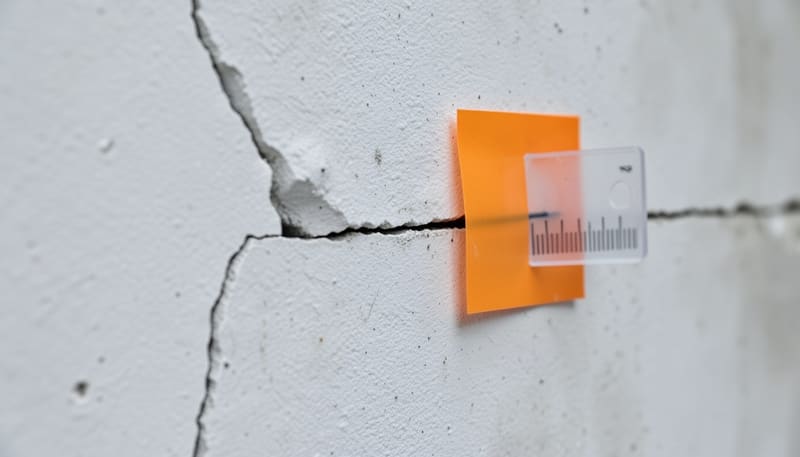
Fixed across the crack with one part on each side, so opening, closing or sliding shows against the scale.
Crack width gauges
Width measured at the same marked points on every visit.
Fixed reference points
Calibrated measurements between marked points, so each reading is comparable with the last.
Photos each visit
Every reading photographed from the same position as the baseline.
Scheduled visits
Timed around excavation, piling or demolition, and agreed in your quote.
Running log
Each reading added to a log against its baseline, so change is visible at a glance.
// Reading the results
Stable, seasonal or progressive: what do the readings show?
Comparing each reading with the baseline puts a crack into one of three patterns. Each one leads to a different response.
- Stable. Readings stay at the baseline. The crack isn't moving while the works go on.
- Seasonal. The crack opens and closes as soil moisture changes, which is typical of houses on reactive clay.
- Progressive. The crack keeps widening. It's reported promptly with the engineer's comment so the builder and owner can respond.
Why seasonal matters
Without repeat readings, a crack that opened over a dry summer can look like damage from the works. A baseline and a series of readings let the engineer separate seasonal movement from movement caused by excavation or vibration.
Illustrative example: three ways a monitored crack can behave
- Stable
- Seasonal
- Progressive
View the data
| Months since baseline reading | Stable | Seasonal | Progressive |
|---|---|---|---|
| 0 | 0 | 0 | 0 |
| 1 | 0 | 0.15 | 0.1 |
| 2 | 0.05 | 0.3 | 0.2 |
| 3 | 0 | 0.4 | 0.35 |
| 4 | 0.05 | 0.3 | 0.5 |
| 5 | 0 | 0.15 | 0.6 |
| 6 | 0 | 0 | 0.75 |
| 7 | 0.05 | -0.15 | 0.9 |
| 8 | 0 | -0.25 | 1 |
| 9 | 0 | -0.15 | 1.15 |
| 10 | 0.05 | 0 | 1.3 |
| 11 | 0 | 0.15 | 1.45 |
| 12 | 0 | 0.3 | 1.6 |
// How it works
How does crack monitoring work during construction?
Readings are tied to the risky stages of the works, and every one is logged against its baseline.
- Before works
Select the cracks
Chosen with you from the dilapidation report's crack register: those closest to the works, in structural elements, or already flagged.
- Before the risky work
Fix points and take a baseline
Gauges or marked points fixed across each crack, with a baseline reading before excavation, piling or demolition.
- During works
Read on schedule
Readings follow the agreed schedule, timed around the riskiest stages.
- If anything moves
Report changes promptly
The reading, photos and the engineer's comment, sent to the builder and owner.
- After the risky works
Take final readings
Final readings compared with the baseline, with a post-construction report if needed.
| Point | Location | Stage | Baseline | Reading | Change |
|---|---|---|---|---|---|
| MP-01 | Boundary wall | Pre-excavation | 2.0 mm | 2.0 mm | 0.0 mm |
| MP-01 | Boundary wall | Bulk excavation | 2.0 mm | 2.1 mm | +0.1 mm |
| MP-02 | Bed 2 ceiling | Bulk excavation | 0.5 mm | 0.9 mm | +0.4 mm |
| MP-03 | Garage slab | Piling | 3.0 mm | 3.0 mm | 0.0 mm |
A running log, not a pile of photos: every reading adds a line, so anyone can see at a glance whether anything has moved.
Quote crack monitoring// When it's worth it
When is crack monitoring worth it?
When a crack moving would be costly to argue about later. Projects that benefit most:
- Excavation close to a boundary, especially for basements
- Piling, rock breaking or other work that causes vibration
- Older masonry buildings, or neighbours with existing cracking
- Long projects where a dispute would be costly and slow
- Cracks that may still be moving, before anyone decides on repairs
Start with the baseline
Book a pre-construction dilapidation report first. We'll recommend which cracks, if any, are worth monitoring, and quote both together.
Already worried about a crack in your own home? A building condition assessment explains what it means, and monitoring shows whether it's still moving. If works are starting next door, read what to do if construction damages your house.
See how our reports are priced or our sample report with its crack register.
// Related services
Other reports we prepare
Pre-construction dilapidation reports
Record every neighbouring property before demolition, excavation or piling starts.
Learn more After the works · Damage concernsPost-construction reports
Re-inspect after works, compare against the original record and assess likely cause.
Learn more Owners · Buyers · Strata committeesBuilding condition assessments
An engineer's view of what defects mean, what's causing them and what to fix first.
Learn more// Questions
Crack monitoring FAQs
Still unsure? Call 07 2150 0579 and an engineer will talk it through.