
The short answer
A dilapidation report in Melbourne is a dated, engineer-signed record of a property's condition before nearby demolition, excavation or construction. It matters here because many suburbs have reactive clay soils and older homes often already have seasonal cracks, so a measured baseline is the clearest way to show what's new. Ours start from $390 + GST, with council assets included on request.
Dilapidation report Melbourne: quick facts
- Typical properties
- Victorian and Edwardian terraces, weatherboards, brick homes and townhouses
- Common triggers
- Townhouse developments, knock-down rebuilds and basements
- Ground
- Reactive clay in many suburbs, so seasonal cracks are common
- Law note
- Part 7 of the Building Act 1993 covers protection of adjoining property
- Signed by
- A structural engineer
- Price
- From $390 + GST, fixed quote in 1–2 business hours
Why do Melbourne homes need a dilapidation report?
Because Melbourne's growth is happening in established streets. Townhouse developments, knock-down rebuilds and basements go in beside Victorian and Edwardian homes, and inner-suburb terraces often share a party wall with the property being rebuilt. Add reactive clay, and many older homes already have cracks before any work starts next door.
Victorian and Edwardian terraces
A shared party wall means works next door act directly on your structure. We record both faces where access allows, plus the rooms either side.
Weatherboards on stumps
Timber homes tend to show movement as sticking doors, sloping floors and gaps in linings rather than long masonry cracks, so we record those too.
Bluestone and brick
Many older homes have bluestone footings, plinths or boundary walls. Existing cracks, open joints and lean are logged before works.
Townhouses and apartments
Infill sites often put several new dwellings beside existing homes, and larger apartment sites bring basements, piling and cranes.
What works trigger a dilapidation report in Melbourne?
Any work that could plausibly affect a neighbouring property. In Melbourne, common triggers include:
- Townhouse developments replacing a single house, often built close to side boundaries
- Knock-down rebuilds beside older brick and timber homes
- Basement excavation for homes, apartments and car parks
- Works to a shared terrace wall, including demolition of the attached terrace
- Removing large trees or changing drainage near a boundary, which can change soil moisture in reactive clay
- Apartment construction with cranes, piling and heavy trucks beside existing buildings
Not sure your project needs one? Read when a dilapidation report is required.
How does reactive clay affect a dilapidation report?
It makes the baseline more important. Reactive clay swells when wet and shrinks as it dries, and houses on it often show cracks that open and close with seasonal moisture changes. Without widths measured before works start, it's hard to show whether a crack is seasonal, old or new.
Ground varies across Melbourne. AS 2870 groups sites into classes by how much the ground surface is expected to move with moisture changes, and a geotechnical report classifies a particular site.
AS 2870 site classes by expected surface movement
- Class A · little or no movementMinimal
- Class S · slightly reactive0–20 mm
- Class M · moderately reactive20–40 mm
- Class H1 · highly reactive40–60 mm
- Class H2 · highly reactive60–75 mm
- Class E · extremely reactive> 75 mm
Seasonal isn't the same as new
A crack that opens in a dry summer and closes again in a wet winter can look like fresh damage. Measured readings from before the works, and repeat readings afterwards, let an engineer tell seasonal movement from a crack that keeps widening. If movement needs tracking over time, ask about crack monitoring.
What is protection work in Victoria?
Part 7 of the Building Act 1993 covers protection of adjoining property. Where building work could affect a neighbouring property, it sets out a process for protection work. Whether it applies, and what it involves, depends on your project, so check with your building surveyor.
A separate record of condition
Whatever process applies, a dilapidation report gives both owners a dated, measured record of condition to rely on. It doesn't decide who is responsible for damage. This is general information, not legal advice.
Worried about who pays, or a neighbour who won't allow access? Read who pays for a dilapidation report and can a neighbour refuse an inspection.
Can council assets be included in a Melbourne dilapidation report?
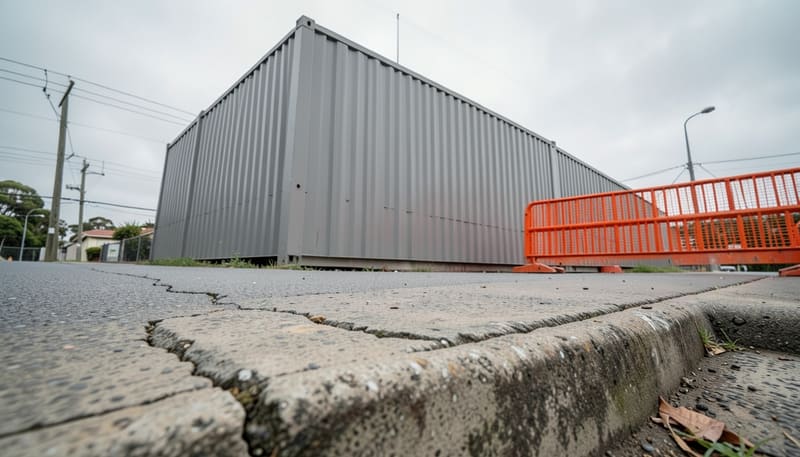
Yes. Many Melbourne councils ask builders to record the condition of council assets at the frontage, such as footpaths, kerbs, crossovers and nature strips, before building works start, often as part of an asset protection permit. We can include these assets in your dilapidation report. Your council sets the exact requirements, so check them when you book.
Send the council's requirements
Include your council's asset protection requirements with your quote request, so the report covers exactly the assets and format they ask for.
What do we record in a Melbourne dilapidation report?
Everything a later damage claim could point to, located and photographed so it can be found again:
- Adjoining homes, inside and out, with numbered photos of every elevation and accessible room
- Both faces of shared terrace walls where access allows, plus the rooms either side
- Existing seasonal cracking, with each crack's location, width, length and orientation measured
- Sticking doors, sloping floors and lining gaps in weatherboard and timber homes
- Bluestone, brick and rendered boundary walls, fences and paving near the works
- Council assets at the frontage when required
Cracks can be rated against the AS 2870 damage categories, from Category 0 (hairline) to Category 5 (very severe). See how a finished report is laid out in our sample dilapidation report, or read which standards reports reference.
How a Melbourne dilapidation report works
Six steps from permit to final comparison. The first five happen before anyone touches the site.
- As soon as you have a permit
Check your permits and conditions
Read your building permit, any planning permit conditions and your council's asset requirements. Your building surveyor can tell you whether protection work applies.
- Weeks before works
Send the address and requirements
We reply with a fixed quote within 1–2 business hours, covering each property and any council assets to record.
- Before the inspection
Arrange access with neighbours
A short letter explaining that the report protects both parties usually helps owners agree to internal access.
- Before demolition or excavation
Inspect and measure
Rooms and elevations are photographed, existing cracks are measured, and shared walls and council assets are recorded.
- Before works start
Issue signed reports
Each owner receives the record of their own property, ready to share with the builder, building surveyor or council if required.
- After works finish
Compare with repeat readings
Recorded cracks are re-measured and new defects logged. On reactive clay, the engineer takes the season into account when comparing readings.
How much does a dilapidation report cost in Melbourne?
Our Melbourne dilapidation reports start from $390 + GST for a typical house, signed by a structural engineer. The fixed price depends on the property's size, how many properties need recording, inside access and whether council assets are included.
See how dilapidation report pricing works, then get a fixed quote. Building the townhouses? Start with a pre-construction report. Works starting next door? Get your own neighbour report. Works finished and worried about new cracks? Book a post-construction report.
Standards and legislation referenced
- Building Act 1993 (Vic), Part 7. Protection of adjoining property
- Standards Australia, AS 2870-2011 Residential slabs and footings. Site classification, and Appendix C, Table C1: classification of damage to walls