The short answer
Record the damage straight away with dated photos and measurements, tell the builder in writing, and don't repair anything until it has been inspected. Then get an independent engineer to inspect and give an opinion on likely cause. If a dilapidation report was done before the works, ask for a copy: comparing against it is the strongest evidence you can have.
Key takeaways
- Photograph and measure new cracks the day you notice them.
- Put everything in writing to the builder, with dates.
- Don't patch or paint over cracks until they've been recorded, unless it's unsafe.
- An independent engineer's opinion on cause is what moves a dispute forward.
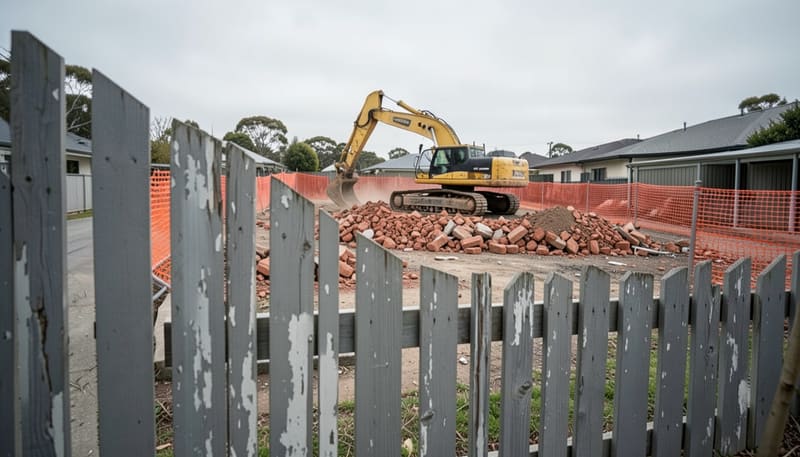
Finding a new crack while an excavator works next door is stressful, and it's natural to want it fixed quickly. The steps you take in the first few days decide how strong your position is later, so it pays to slow down, record everything and get the right advice before anyone picks up a trowel.
What to do in the first days after noticing damage
Work through these steps in order. The first four take an afternoon and cost nothing.
- Straight away
Make it safe
If anything looks unstable, such as a leaning wall, a fence pulling away or a crack opening quickly, keep people clear and tell the builder immediately. If there's immediate danger, call emergency services.
- The same day
Record it
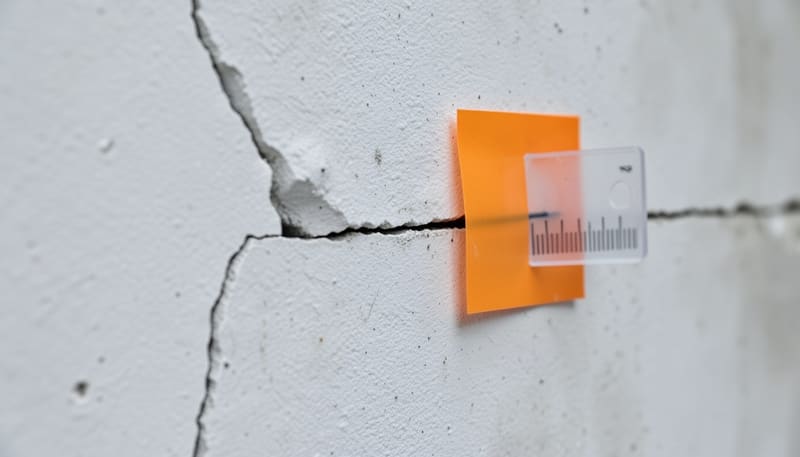
Photograph each crack close up with a ruler or coin for scale, then take a wider shot showing where it is in the room or wall. Keep the original image files, not just copies sent by message.
- The same day
Measure and mark
Mark the ends of each crack lightly in pencil with the date, and note its width against a ruler or crack width card. If it grows past the mark, you'll know.
- Within a day or two
Notify the builder in writing
Email the builder or owner doing the works with your photos and a list of what you've noticed. Ask what work was happening, and whether a dilapidation report of your property was done before it started.
- Before any repair
Don't repair yet
Leave cracks unpatched and unpainted until they've been inspected and measured, unless a temporary fix is needed for safety or to keep water out. Repairing first can remove the evidence.
- As soon as you can
Get a post-construction inspection
An independent engineer records the damage, compares it with any earlier record and gives an opinion on likely cause. That's what a post-construction dilapidation report is for.
- Early
Tell your insurer
Let your home insurer know, check what your policy covers, and ask the builder for their insurer's details. Keep a copy of everything you send.
- While works continue
Keep watching
If the works are still under way, crack monitoring shows whether the damage is stable or still developing.
What are the signs that building work next door is damaging my house?
The usual signs are new or widening cracks, especially on the side of the house closest to the works, and doors or windows that suddenly start to stick. Look for:
- New cracks near the boundary closest to the works
- Existing cracks that widen or lengthen during excavation, piling or demolition
- Doors and windows that start sticking or won't latch
- Gaps at cornices, skirting boards or between walls and ceilings
- Floors that feel out of level or slope towards the works
- Cracked tiles, paving or driveway slabs on the works side
- Boundary walls, fences or retaining walls leaning towards an excavation
- Leaking or blocked pipes and drains near the works
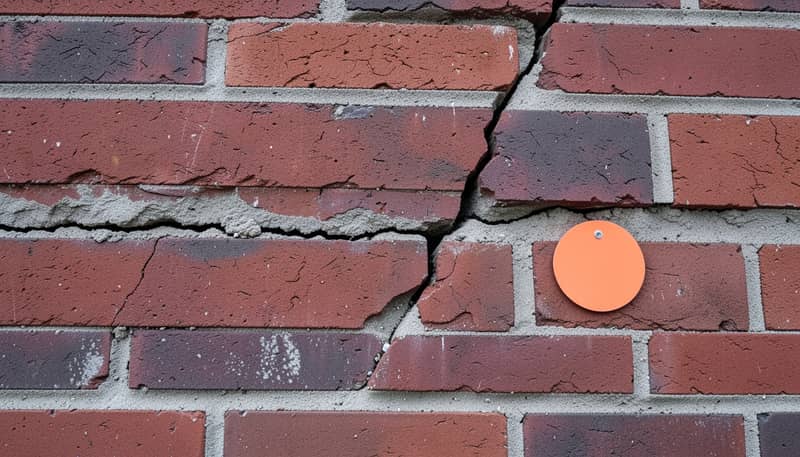
To describe how serious a crack is, engineers commonly use the damage categories in AS 2870, from Category 0 (negligible, under 0.1 mm) to Category 5 (very severe, over 25 mm), with width as a guide only. Our guide to dilapidation report standards explains how they're applied.
Not every crack that appears during nearby works is caused by them. Seasonal movement of reactive clay, leaking pipes, trees and ageing materials all crack houses too. That's why an engineer's opinion matters more than an assumption either way.
Did the works cause the crack, or something else?
Sometimes the works are the cause and sometimes they aren't. An engineer weighs the crack's pattern, location, timing and any earlier record against the type and position of the works.
| Possible cause | What an engineer looks at |
|---|---|
| Excavation next door | Whether your footings sit within the excavation's zone of influence, whether cracking is concentrated on the side facing the dig, and when it appeared |
| Vibration from piling, rock breaking or compaction | Timing against the vibrating work, distance from the source, any vibration monitoring records and how sensitive the building is |
| Demolition and heavy machinery | Damage near where machines worked or trucks passed, including fences, paving and shared walls |
| Seasonal movement of reactive clay | Cracks that open and close with wet and dry seasons, and whether they appear in earlier records |
| Leaking pipes or poor drainage | Localised movement near wet areas, staining and recent plumbing problems |
| Trees and ageing materials | Cracking near large trees, and long-term deterioration such as weak or eroded mortar |
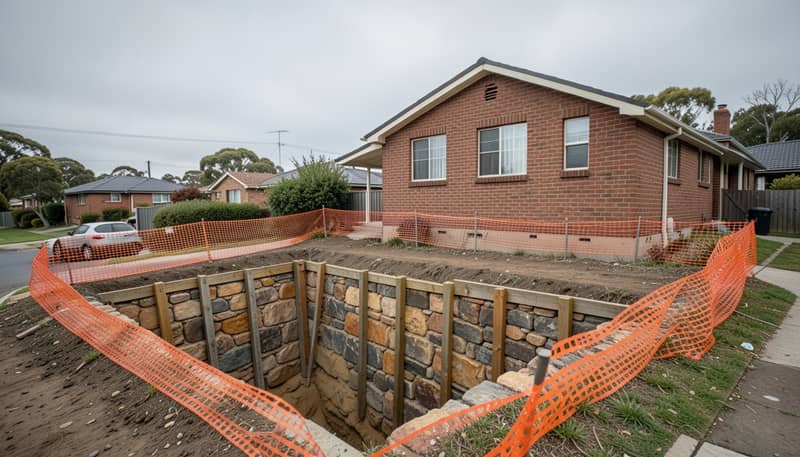
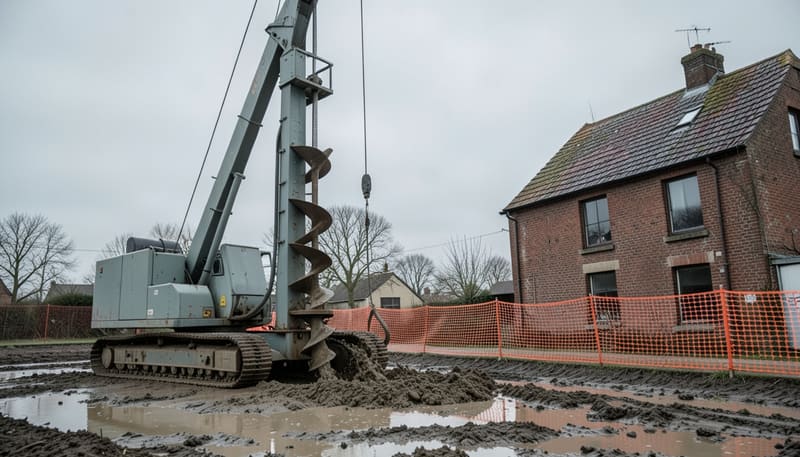
Excavation takes support away from the ground beside it. A common rule of thumb draws a line up from the base of the excavation at about 45°, flatter in soft or wet ground. Footings above that line are within the zone of influence, and are the ones most likely to move if the excavation isn't properly supported.
Is the neighbour's footing within the zone of influence?
How much vibration can damage a house?
Engineers in Australia commonly judge vibration risk against guideline values in the German standard DIN 4150-3. For dwellings, the guideline is 5 mm/s peak particle velocity (PPV) at the foundation for vibration below 10 Hz, rising to 15–20 mm/s at higher frequencies. These are guideline values used by engineers, not legal limits.
Peak particle velocity is how fast the ground or structure moves as the vibration passes, measured in millimetres per second. Low-frequency vibration, the kind that heavy plant and piling tend to produce, gets the lowest guideline values because buildings respond to it most.
DIN 4150-3 guideline vibration values by building type
- Commercial / industrial
- Dwellings
- Sensitive / heritage
View the data
| Frequency (Hz) | Commercial / industrial | Dwellings | Sensitive / heritage |
|---|---|---|---|
| 1 | 20 | 5 | 3 |
| 10 | 20 | 5 | 3 |
| 50 | 40 | 15 | 8 |
| 100 | 50 | 20 | 10 |
Some engineers also reference the British standard BS 7385-2, which gives guideline values for residential buildings of 15 mm/s at 4 Hz, rising to 20 mm/s at 15 Hz and 50 mm/s at 40 Hz and above. If piling or rock breaking is happening next door, ask the builder whether vibration is being monitored, and for the readings if it is.
Guideline values, not legal limits
Going over a guideline value doesn't prove damage, and staying under one doesn't rule it out. A building's age, condition and existing cracks all affect how it responds, which is why an engineer looks at the house as well as the numbers.
Is the crack still moving? How crack monitoring works
One measurement tells you how wide a crack is today. Repeat readings tell you whether it's stable, seasonal or still growing.
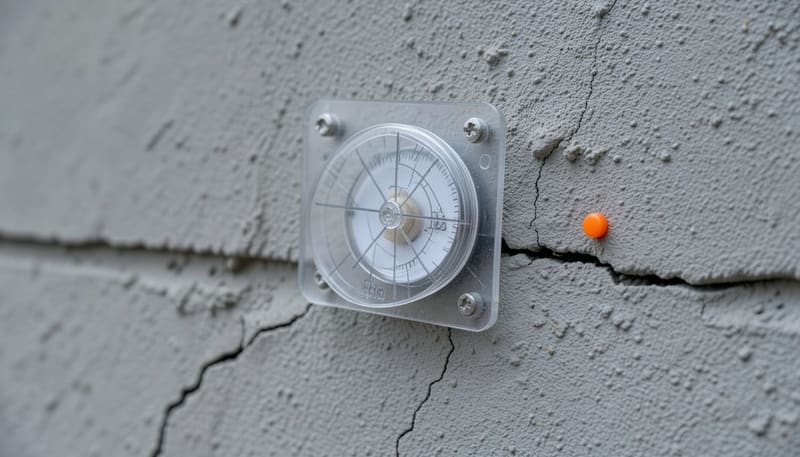
Crack monitoring uses tell-tale gauges fixed across a crack, crack width gauges and calibrated measurements, read at set intervals. Each reading is compared with the baseline, ideally the measurement in a pre-construction dilapidation report, to show which of three patterns the crack is following.
Illustrative example: three patterns of crack readings over a year
- Stable
- Seasonal
- Progressive
View the data
| Months since baseline | Stable | Seasonal | Progressive |
|---|---|---|---|
| 0 | 0.5 | 1.1 | 0.8 |
| 2 | 0.5 | 1.4 | 1.1 |
| 4 | 0.5 | 1.5 | 1.5 |
| 6 | 0.5 | 1.2 | 1.8 |
| 8 | 0.5 | 0.9 | 2.2 |
| 10 | 0.5 | 0.9 | 2.5 |
| 12 | 0.5 | 1.1 | 2.9 |
Houses on reactive clay often show cracks that open and close with seasonal moisture changes. Without a baseline and repeat readings, a seasonal crack measured at its widest can look like new damage, and a progressive one can be written off as seasonal. Measurements settle it.
Still widening during the works?
If your marks or readings show a crack is still growing while work continues next door, tell the builder in writing straight away, send the readings and ask for an engineer's inspection. Don't wait for the works to finish.
What if there was no dilapidation report?
It's harder, but not hopeless. First, ask the builder anyway: a report of your property may exist that you haven't been given. If there really is no baseline, an engineer can record the current condition and assess which defects appear recent, for example:
- Clean, sharp crack edges with no paint, dust or dirt inside the crack
- A position and pattern consistent with the type and location of the works
- Timing that matches the works, supported by your dated photos and emails
Without a baseline that opinion carries more uncertainty, and a good report will say so honestly. If works are still going, a neighbour dilapidation report now fixes a baseline for everything that happens from here. If you mainly want to understand what existing defects mean, a building condition assessment may suit better.
What to do, and what to avoid
Do
- Put every report of damage in writing, with dates
- Keep original photos and a simple log of what you noticed and when
- Ask for a copy of any dilapidation report of your property
- Get an independent engineer's opinion before agreeing on repairs
- Tell your home insurer early
Don't
- Patch, fill or paint cracks before they're recorded and measured
- Rely on verbal promises made over the fence
- Enter the building site to look or take photos
- Assume every crack was caused by the works, or that none were
- Agree on a repair scope before the damage has been assessed
Who is responsible for fixing the damage?
That's a matter between you, the owner or builder doing the works, and their insurers, and sometimes a legal question. An engineer's report doesn't decide responsibility, but it provides the independent evidence those discussions rely on.
The legal background
In NSW, section 177 of the Conveyancing Act 1919 provides a right of support for land. In Victoria, Part 7 of the Building Act 1993 covers protection of adjoining property through the protection work process. Elsewhere, check the development approval or building permit conditions for the works. For your rights in a particular situation, get legal advice.
Councils commonly include dilapidation conditions in development consents for excavation, demolition and piling near boundaries, so it's worth asking whether one applied to the works next door. Read when a dilapidation report is required and who pays for a dilapidation report.
What an independent engineer's report adds
A builder and a neighbour looking at the same crack often see different things. An independent engineer's report replaces that argument with measurements, photographs and a reasoned opinion, from someone with no stake in the repair work.
- What we do
- Inspect, measure and record the damage, and compare it with any earlier report
- What you get
- An engineer's opinion on likely cause, with its limits stated clearly
- What we don't do
- Quote for, recommend or carry out repairs
- Time on site
- One to three hours for a typical house
- Signed by
- A structural engineer (Engineers Australia · RPEQ)
- Quote
- Fixed price within 1–2 business hours
We assess cause, we don't repair
Because we never quote for repairs, our opinion has no stake in what the fix costs or who pays for it. That independence is what makes the report useful to you, the builder and the insurers.
Not sure whether you need an engineer or a building inspector? Read engineer vs building inspector. Ready to act? Request a post-construction inspection and we'll send a fixed quote within 1–2 business hours.
Sources and standards referenced
- DIN 4150-3 (German standard on the effects of vibration on structures). Guideline values for short-term vibration at the foundation
- BS 7385-2 (British standard guide to damage levels from groundborne vibration)
- Standards Australia, AS 2870-2011 Residential slabs and footings. Appendix C, Table C1: classification of damage to walls
- Conveyancing Act 1919 (NSW), section 177. Right of support for land
- Building Act 1993 (Vic), Part 7. Protection of adjoining property