
The short answer
There isn't an Australian Standard written specifically for dilapidation reports. Reports commonly reference AS 4349.0-2007, the general requirements for inspecting buildings, and many inspectors cite AS 4349.1-2007, the pre-purchase inspection standard. Crack severity is commonly rated with the damage categories in AS 2870-2011 Appendix C. What makes a report defensible is a consistent method, measured defects and a qualified signature.
Key takeaways
- No Australian Standard is written specifically for dilapidation reports.
- AS 2870 damage categories, from 0 to 5, are widely used to rate wall cracks.
- AS 2870 site classes explain why some houses crack and recover with the seasons.
- Your consent conditions may set specific requirements, and they take priority.
People usually search for "the Australian Standard for dilapidation reports" for one of two reasons: a council, builder or lawyer has asked for a compliant report, or they want to know whether a report they've received is any good. Both answers start in the same place: which standards apply to which part of the job.
Dilapidation reports and standards: quick facts
- Dedicated standard
- None written specifically for dilapidation reports
- General inspections
- AS 4349.0-2007, general requirements
- Often cited
- AS 4349.1-2007, pre-purchase inspections of homes
- Crack categories
- AS 2870-2011 Appendix C, Table C1 (Categories 0 to 5)
- Site classes
- AS 2870: Classes A, S, M, H1, H2, E and P
- Vibration guidance
- DIN 4150-3 and BS 7385-2 guideline values
Which standards do dilapidation reports reference?
Three Australian Standards come up most often, plus two overseas standards for vibration. None was written for dilapidation reports, so each is used for a specific part of the job.
| Standard | What it covers | How reports use it |
|---|---|---|
| AS 4349.0-2007 Inspection of buildings, Part 0 | General requirements for inspecting buildings | Some providers align their inspection method and reporting with it |
| AS 4349.1-2007 Inspection of buildings, Part 1 | Pre-purchase inspections of residential buildings | Many inspectors cite it, though it was written for buyers, not for a baseline before works |
| AS 2870-2011 Appendix C | Damage categories for walls, based mainly on crack width | To rate wall cracks consistently, from Category 0 to 5 |
| AS 2870-2011 site classification | Site classes by expected ground surface movement | To explain why some cracks open and close with the seasons |
| DIN 4150-3 and BS 7385-2 | Guideline vibration values for building damage risk | When piling, rock breaking or compaction is planned nearby |
What does AS 4349 cover, and does a dilapidation report have to follow it?
Not unless your consent conditions or contract say so. AS 4349 is a series of standards for inspecting buildings, and none of its parts is about recording condition before nearby works.
AS 4349.0 sets general requirements that apply to building inspections. Some providers align their dilapidation method with it, for example in how the scope is agreed and how limitations are stated.
AS 4349.1 is the pre-purchase standard. It helps a buyer understand a home's condition before they commit. Many inspectors cite it because it's the standard they work with every day, but a pre-purchase inspection asks a different question. A buyer wants to know whether there are significant defects. A dilapidation report needs to record every defect, however minor, so it can be compared after the works.
Check the content, not the citation
A report that says it was prepared with reference to AS 4349 isn't automatically better than one that doesn't. Check what it actually records: measured cracks, inside rooms and photos located on a plan matter more than the reference.
How does AS 2870 rate crack damage?
AS 2870-2011 Appendix C, Table C1 sorts damage to walls into six categories, from Category 0 (negligible, hairline cracks under 0.1 mm) to Category 5 (very severe, over 25 mm). Crack width is a guide only.
- Cat 0Negligible< 0.1 mm
Hairline cracks.
- Cat 1Very slight< 1 mm
Fine cracks which do not need repair.
- Cat 2Slight< 5 mm
Cracks noticeable but easily filled. Doors and windows stick slightly.
- Cat 3Moderate5–15 mm
Cracks can be repaired; some wall may need replacing. Doors and windows stick, service pipes can fracture, weathertightness often impaired.
- Cat 4Severe15–25 mm
Extensive repair: sections of wall broken out and replaced. Frames distort, walls lean or bulge, some loss of bearing in beams.
- Cat 5Very severe> 25 mm
Major repair, partial or complete rebuilding. Beams lose bearing, walls lean badly and need shoring. Danger of instability.
The categories give owners, builders, engineers and insurers a shared language. "Category 1, very slight" means the same thing to everyone, where "a small crack" doesn't. That's why engineers use them even though AS 2870 is a footing design standard, not an inspection standard.
Width isn't the whole story. The number, pattern and location of cracks also matter: several fine cracks in one wall can be more significant than one wider crack. The categories also describe walls only, so paving, fences and other site elements are recorded and measured but not categorised.
How a good report applies AS 2870 to each crack
Each crack goes through the same steps, so it can be found, re-measured and compared after the works.
- Step 1
Locate and reference
Give the crack a reference number and mark its position on the floor plan or elevation.
- Step 2
Measure
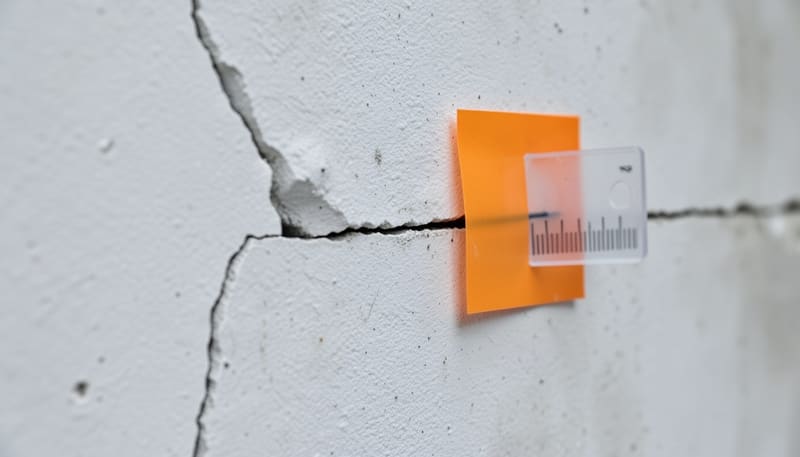
Measure its width with a crack width gauge and its length with a tape.
- Step 3
Describe
Note its orientation (vertical, horizontal, diagonal or stepped) and the material it runs through, such as brick, render or plaster.
- Step 4
Photograph
Photograph it with the gauge in shot, and link the photo number to the crack register entry.
- Step 5
Rate
Assign an AS 2870 damage category as a guide, noting the number, pattern and location of cracks as well as width.
- After the works
Re-measure and compare
A post-construction inspection re-measures the same crack at the same spot and records any change.
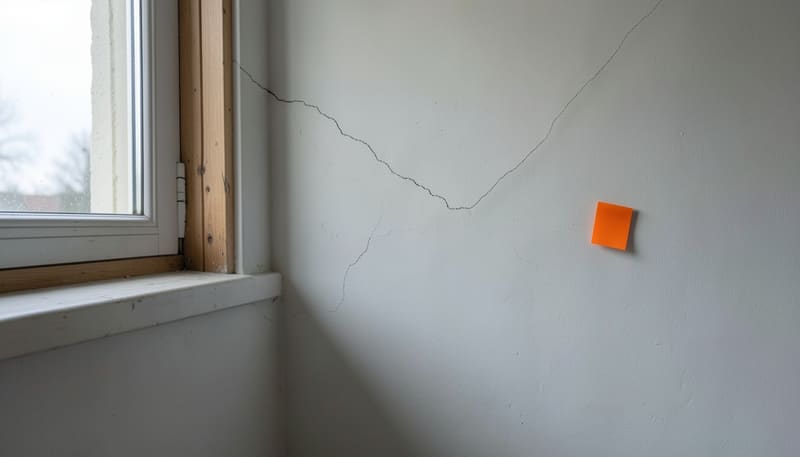
The result is a crack register: one line per crack, linked to its photo. Here's what three entries might look like.
| Ref | Location | Element | Orientation | Width | Length | Photo | Category |
|---|---|---|---|---|---|---|---|
| C-01 | Bedroom 2 | Plaster wall | Diagonal | 0.8 mm | 450 mm | P-021 | Cat 1 |
| C-02 | Side elevation | Brick veneer | Stepped | 2.0 mm | 900 mm | P-008 | Cat 2 |
| C-03 | Hallway | Cornice | Horizontal | <0.1 mm | 1,200 mm | P-030 | Cat 0 |
Width guides the category. The number, pattern and location of cracks also matter, so the engineer notes them too. See a fuller example in our sample dilapidation report.
What are AS 2870 site classes, and why do they matter?
AS 2870 classifies sites by how much the ground surface is expected to move as soil moisture changes, called the characteristic surface movement (ys). The more reactive the clay, the more a house on it can move, and the more its cracks may open and close with the seasons.
AS 2870 site classes by characteristic surface movement (ys)
- Class A · sand and rockLittle or none
- Class S · slightly reactive0–20 mm
- Class M · moderately reactive20–40 mm
- Class H1 · highly reactive40–60 mm
- Class H2 · highly reactive60–75 mm
- Class E · extremely reactiveOver 75 mm
Class P covers problem sites, such as soft soils, fill, trees or abnormal moisture conditions. These don't fit the movement scale and need engineering judgement.
A dilapidation report doesn't classify the neighbouring site, but knowing a house sits on reactive clay helps an engineer read its cracks. Houses on reactive clay often show cracks that open and close with seasonal moisture changes. A crack measured in a dry spell can be wider than the same crack after rain, with no help from the works next door. That's why a baseline before works, and repeat readings, matter. Our guide to construction damage next door shows what stable, seasonal and progressive readings look like, and crack monitoring tracks them over time.
Is there a standard for construction vibration?
For building damage risk from vibration, engineers in Australia commonly reference the German standard DIN 4150-3, and sometimes the British standard BS 7385-2. Both give guideline values, not legal limits.
The values are peak particle velocity at the foundation for short-term vibration. They rise with frequency: under DIN 4150-3, dwellings go from 5 mm/s below 10 Hz to 15–20 mm/s between 50 and 100 Hz, and under BS 7385-2, residential values rise to 20 mm/s at 15 Hz and 50 mm/s at 40 Hz and above. See the full chart in our guide to what to do if construction next door damages your house.
What makes a dilapidation report defensible?
In a dispute, nobody asks which standard a report cited. They ask whether it proves what the property looked like before the works. A defensible report has:
Dated, located photos
Taken in a consistent sequence and indexed to a plan, so each can be retaken from the same spot.
Measured defects
Crack width, length and orientation in a register, not just a photo.
A recognised rating
AS 2870 damage categories applied consistently, as a guide.
Clear limits
What was and wasn't accessed, and the conditions on the day.
A qualified signature
Signed by someone independent of the works and of any repairs.
A repeatable method
Structured so a post-construction inspection can follow it step by step.
Who signs the report matters as much as what's in it. Read engineer vs building inspector to see what a structural engineer adds.
Independence is part of it
A report written by someone who might be paid to fix the damage is easier to challenge. We're engineering only: we inspect, record, report and advise, and never quote for or carry out repairs.
When your consent conditions set the format
If your development consent, permit or contract sets requirements for the report, follow them first. They take priority over any general practice.
Councils commonly include dilapidation conditions in development consents for excavation, demolition and piling near boundaries. A condition usually names the properties to record, when the report is due and who receives a copy, and it may also say who must prepare the report and what it must cover. Read it before you request quotes. Our guide to when a dilapidation report is required explains how to find and read yours.
State by state
In NSW, section 177 of the Conveyancing Act 1919 provides a right of support for land. In Victoria, Part 7 of the Building Act 1993 covers protection of adjoining property. In other states, check your development approval or building permit conditions.
Send us the condition wording with your quote request and we'll scope the report to meet it, whether that's a pre-construction report of each neighbouring property or a commercial dilapidation report for a lease or larger building.
Glossary
- AS 2870
- The Australian Standard for residential slabs and footings. Dilapidation reports use its crack damage categories and site classes.
- AS 4349
- A series of Australian Standards for inspecting buildings. Part 0 sets general requirements; Part 1 covers pre-purchase inspections of residential buildings.
- Damage category
- A rating from 0 (negligible) to 5 (very severe) for cracking in walls, from AS 2870 Appendix C.
- Characteristic surface movement (ys)
- The expected movement of the ground surface as soil moisture changes, used to set the site class.
- Reactive clay
- Clay soil that swells when wet and shrinks as it dries, moving footings with the seasons.
- Peak particle velocity (PPV)
- How fast the ground or a structure moves as vibration passes, measured in millimetres per second.
Sources and standards referenced
- Standards Australia, AS 4349.0-2007 Inspection of buildings, Part 0: General requirements
- Standards Australia, AS 4349.1-2007 Inspection of buildings, Part 1: Pre-purchase inspections, residential buildings
- Standards Australia, AS 2870-2011 Residential slabs and footings. Appendix C, Table C1: classification of damage to walls; site classification by characteristic surface movement
- DIN 4150-3 (German standard on the effects of vibration on structures). Guideline values for short-term vibration at the foundation
- BS 7385-2 (British standard guide to damage levels from groundborne vibration)
- Conveyancing Act 1919 (NSW), section 177. Right of support for land
- Building Act 1993 (Vic), Part 7. Protection of adjoining property